
Start With the Product Weight, Not the Film Width
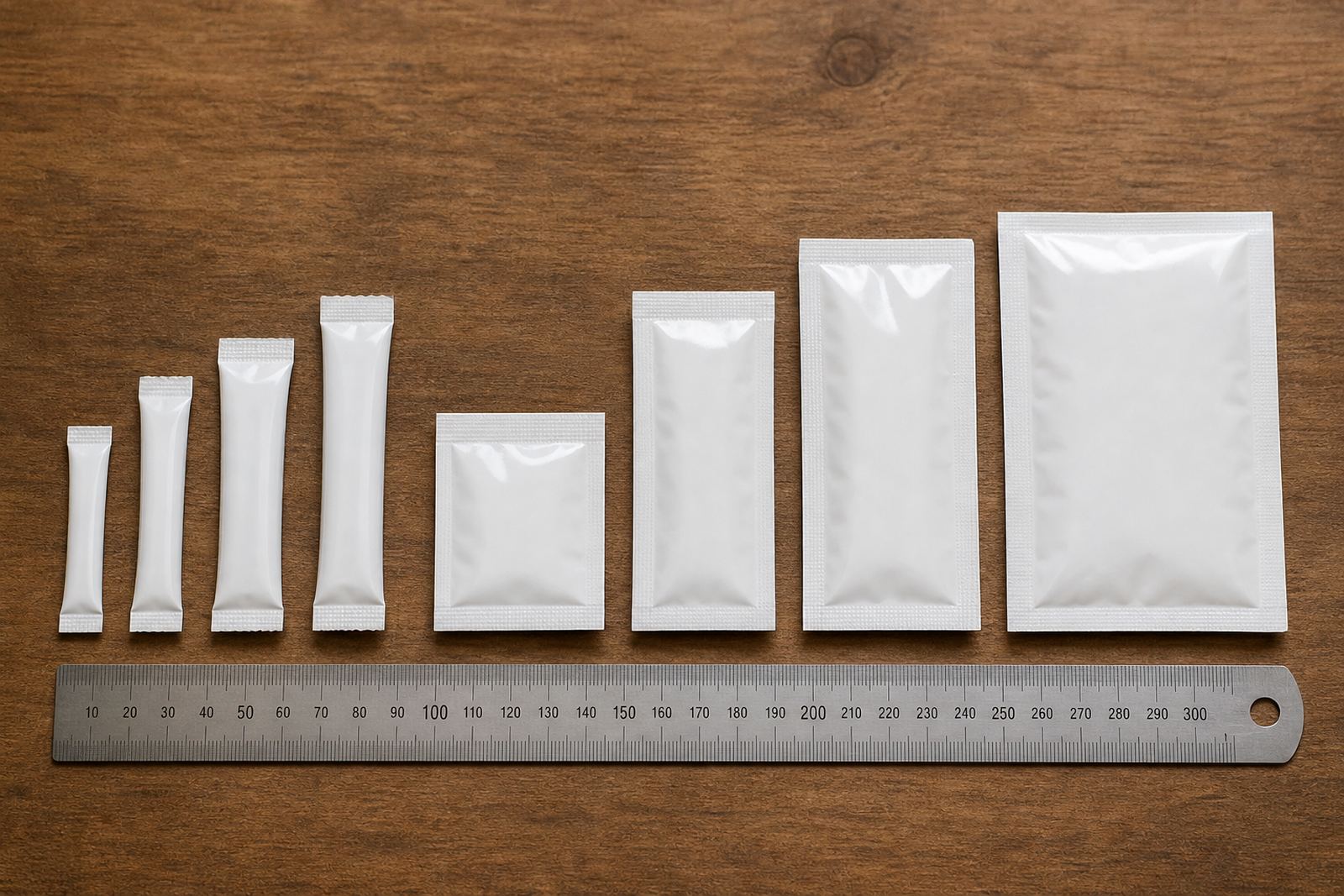
The first step is to work from the product portion itself. A sachet should comfortably hold the intended fill weight without leaving the pack overstuffed or looking too slack once sealed. If the contents are a powder, granule, sauce or liquid, the volume and flow behave differently, so the same gram weight can need a very different sachet shape. That is why size decisions should be based on how the product sits in the pack, not only on a rough guess from another item on the shelf.
For measured portions, the fill weight must also leave enough room for sealing at the top and enough body in the pouch for easy handling. A sachet that is too small can wrinkle around the product or burst at the seal line when packed fast. A sachet that is too large may feel wasteful and can make the portion look smaller than it really is. In practice, a good starting point is to test a few sizes with the actual contents and check how they close, stand and tear.
- Check the product density and how it settles after filling.
- Allow space for the seal margins at the top and sides.
- Test the pack after a few hours, not only straight off the line.
Match Sachet Dimensions to How the Customer Uses It
Handling ease matters just as much as portion size. A sachet that is meant for a single serve coffee mix, condiment, tablet powder or sample pack must be easy to grip, tear and empty. If the pack is awkward to hold, the customer may spill product or struggle to open it cleanly. Smaller sachets are often better for samples and controlled doses while slightly wider formats suit products that need a better grip or a neater pour.
Think about where and how the sachet will be used. A takeaway food counter in Durban may need packs that are quick to open and easy to dispose of, while a wholesale order moving through Johannesburg or Pretoria may need tighter stacking and cleaner carton packing. In coastal areas like Pinetown and Ballito, humidity can also affect how films behave during filling and storage, so a size that looks fine in an office can perform differently on the shop floor.
- Single-use products need simple opening and clear tear points.
- Promotional samples should be compact but still readable.
- Food service packs often need a shape that opens neatly with one hand.
- Longer sachets can suit thin liquids, but they need careful seal control.
Choose a Shape That Prints Well and Packs Cleanly
Sachet size is not only about length and width. The shape affects how the artwork reads, where the seals sit and how much room there is for batch details or ingredient text. A narrow pack may leave very little space for clear panel layout, while a wider sachet gives more room for branding and legal copy. If the print has small type or a detailed design, the available panel size becomes important very quickly.
Flexo printing works best when the sachet layout is planned with the final seal pattern in mind. Artwork placed too close to a seal may distort or disappear after sealing and cutting. It helps to keep important text away from edge zones and to allow space for registration marks, cutter allowance and proofing notes. This saves rework and keeps repeat orders more consistent, especially when the same sachet needs to be produced again months later.
- Leave clear margins for seals and cutting marks.
- Keep key copy away from the edges of the sachet.
- Use the larger printable area for instructions or flavour names.
- Ask for a proof if the sachet carries fine text or small logos.
Consider Filling Speed, Storage and Transport
A sachet that looks ideal on paper may not suit the practical side of production. Filling speed, carton size and transport all influence the right dimensions. If the pack is too wide, it may not stack neatly in cartons. If it is too long, the finished packs can shift around during dispatch and arrive with scuffed seals or curled edges. For local brands sending stock across South Africa, these small issues become costly when a delivery reaches Bloemfontein or Cape Town and the outer cartons have not held shape well.
Short run orders often benefit from a size that is easier to set up and monitor. Repeat production needs consistency, so once a sachet size works, it is worth holding that format for future batches unless the product or fill weight changes. In busy months, load-shedding can also affect line timing and machine starts, so a format that runs cleanly with fewer adjustments is often the safer choice. It helps keep the schedule steady and reduces waste.
- Check how many sachets fit neatly into a carton or inner bag.
- Make sure the pack shape holds up during courier handling.
- Choose a size that can run consistently on repeat jobs.
- Allow for line stops and restarts during production days.
Use Size Testing to Avoid Waste and Guesswork
The most practical way to settle on a sachet size is to test it with the actual product and a few sample runs. Size choices made only from a drawing often miss small but important details such as fill settlement, seal strength and how the pack feels in the hand. A trial also helps identify whether the sachet is easy to tear, whether the seal line stays straight and whether the pack looks balanced when displayed in a carton or tray.
For brands launching in Pinetown, Durban or Johannesburg, this testing phase can save a lot of back-and-forth later. It is easier to adjust the dimensions before full production than to deal with waste after a large run. A small change in width or seal allowance may make the whole pack behave better. That is especially true when the product is sold by the portion and the pack must feel neat, accurate and easy to use.
- Run a sample with the real fill weight and actual seal settings.
- Check opening, pouring and tearing from the customer point of view.
- Compare the look of the pack before and after transport.
- Keep a record of the size that works best for repeat production.
A Pinetown Example for Local Brands
Consider a local condiment brand based near Pinetown that needs sachets for a 10 ml portion. The first thought might be to keep the pack as small as possible, but once the product is filled, the seal line, the grip point and the print area all need space. If the sachet is too tight, the pack can look crowded and the tear line becomes fiddly. If it is too large, the product can sit awkwardly and the shelf presentation suffers. A slightly wider format often gives a better result because it balances handling, neat sealing and clearer print.
For a brand shipping to Durban, Pretoria and Cape Town, that extra bit of planning helps every step after production. The packs stack better, the cartons close more cleanly and the customer gets a sachet that opens properly the first time. That is usually what matters most: a size that suits the product, the process and the person using it. In sachet work, a few millimetres can make the difference between an average pack and one that feels properly considered.
Choosing the right sachet size is not guesswork. It is a practical decision based on portion, handling and the realities of printing and packing. Get those three things right and the finished product has a far better chance of doing its job well.